
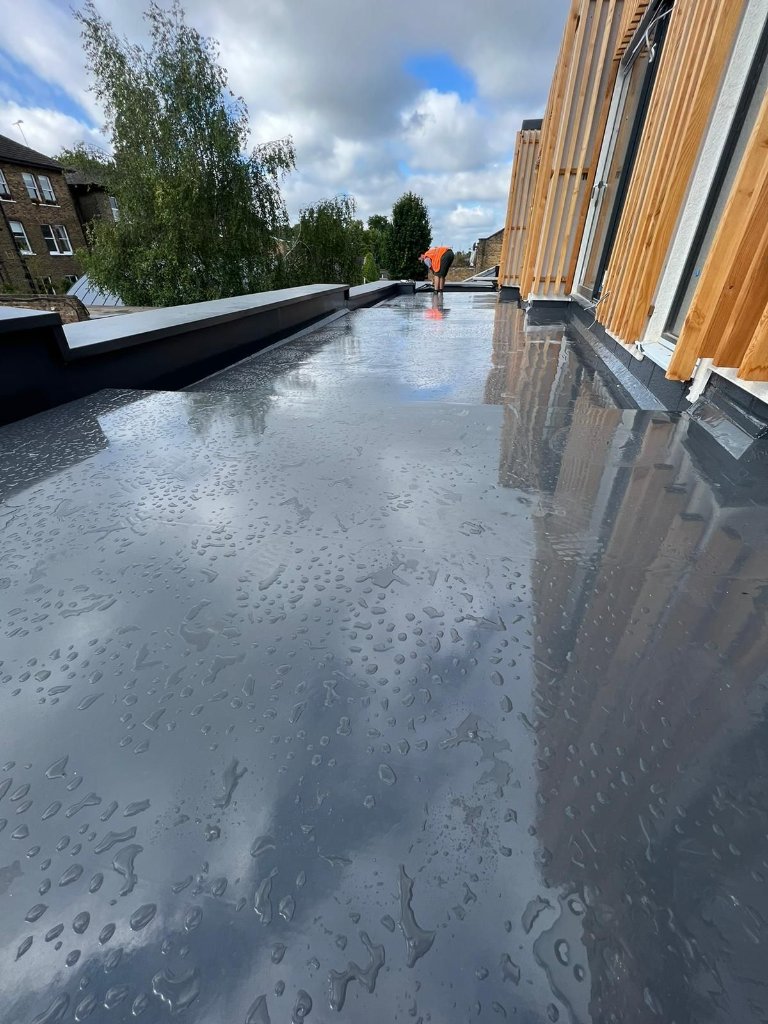
Commercial roof refurbishment.
Refurbishment means keeping useful parts of the existing roof and dealing with the defects that are actually present. Whether that is possible depends on the roof type, the substrate, the extent of deterioration and the details that are failing — not on choosing a product first.
Refurbishment starts with the problem, not the system
A leaking roof may need one failed detail repairing. A corroded metal roof may need local sheet work and a wider protective treatment. An asbestos-cement roof may be capable of repair or encapsulation, or its condition may make another route more appropriate. A flat roof with widespread membrane failure is a different problem again.
The job of the assessment is to establish which of those situations you actually have before money is committed to a repair, coating, overlay or replacement.
Problems that can lead to a refurbishment conversation
Recurring water ingress
Leaks returning after local repairs can indicate that the original ingress route was missed or that deterioration is no longer isolated.
See the problem guideMetal roof corrosion
Cut edges, sheet corrosion, fixings, laps and coating breakdown need separating into repairable details and areas where the sheet itself has deteriorated.
See the problem guideAsbestos-cement deterioration
Weathering, cracks and leaks must be considered alongside the condition of the asbestos-containing material and the work classification.
See the problem guidePonding and drainage problems
Standing water can be a drainage, outlet, fall or roof-build-up issue. A new coating does not correct the wrong underlying cause.
See the problem guideFailed coating or membrane
Peeling, blistering, splitting, delamination or widespread weathering can indicate that the existing waterproofing layer needs more than another local patch.
See the problem guideGutter failure
Box gutters, joints, outlets and corrosion can create internal water ingress independently of the roof covering.
See the problem guideWhat needs checking before refurbishment is specified
Roof type and construction. Profiled steel, asbestos cement, EPDM, felt/asphalt and existing liquid-applied systems have different failure modes and different preparation requirements.
The actual defect pattern. One failed fixing is not the same as widespread fixing failure; an isolated crack is not the same as general membrane breakdown; early edge corrosion is not the same as perforated roof sheeting.
The substrate beneath the visible surface. A new waterproofing layer only performs if the existing roof provides a suitable basis for the proposed system. Where there is uncertainty about moisture, adhesion, structural condition or material condition, that uncertainty needs resolving first.
The junctions. Rooflights, laps, flashings, penetrations, gutters, outlets and edges frequently need their own repair scope rather than being treated as part of a generic field coating.
Repair, refurbish or replace?
| What we find | Possible response | What changes the answer |
|---|---|---|
| Isolated defect | Local repair may be enough | The surrounding roof remains serviceable and the failure can be clearly identified. |
| Several related defects | Repair plus targeted refurbishment may be appropriate | The defects are spreading beyond one detail but the wider roof can still provide a suitable substrate. |
| Widespread surface or detailing failure | Wider refurbishment may be appropriate | The roof needs a planned treatment rather than a series of unrelated patches. |
| Existing roof cannot support the proposed work | Replacement or a different intervention may be needed | Substrate condition, structural condition, trapped moisture or material condition can rule out an overlay/refurbishment route. |
This page explains the options, but the roof must still be inspected before the right one can be confirmed.
Where the roofing systems fit
Once the roof and defect are understood, the appropriate technology can be considered. The system is the response to the condition — it is not the diagnosis.
Metal roof refurbishment
For profiled metal roofs where corrosion, fixings, laps, coatings and sheet condition have been assessed.
Read moreAsbestos-cement roof options
Repair, coating, encapsulation, overcladding or removal are considered against material condition and the intended work.
Read moreLiquid-applied roofing
For suitable flat-roof substrates and complex details where a liquid-applied waterproofing route is appropriate.
Read moreEPDM roofing
A sheet-membrane option for suitable roof construction and detailing.
Read moreSpray-applied roofing
A spray-applied waterproofing technology considered where the substrate, project and chosen system support it.
Read moreCommercial gutter repair
For leaking, corroded or failed commercial gutter systems where repair or lining is viable.
Read moreYou do not need to choose the system before contacting us
If you have photographs, the roof type, approximate area or a description of the problem, send what you have. If you would rather explain it by phone, call us. The next step should be driven by the building problem, not by forcing the project into a product page.
Your roof. Your next step.
Got a problem with a commercial roof?
Tell us what is happening, what type of building it is and where the problem is. If you would rather talk it through, call us directly.