
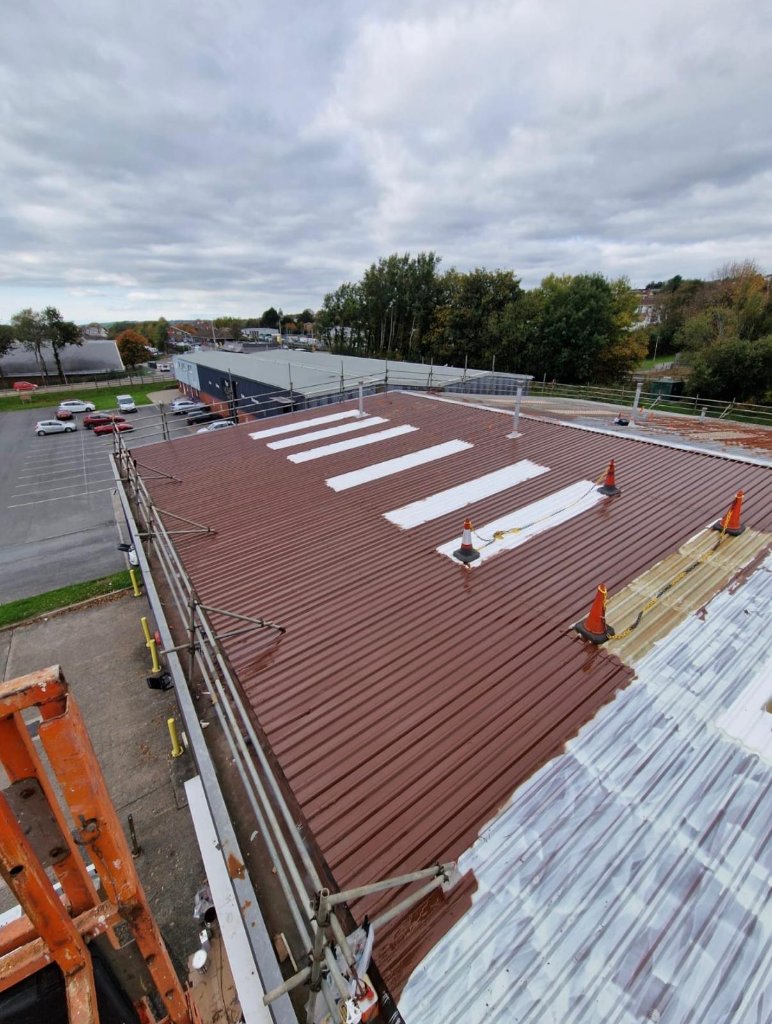
Asbestos Roofs
A technical resource for facilities managers, building owners and estates teams responsible for commercial and industrial asbestos-cement roofing — what the material is, how it ages, the duty to manage it, and the assessed options from local repair through encapsulation and overcladding to removal.
What an asbestos cement roof is
Many profiled asbestos roofs in UK commercial and industrial buildings are asbestos-cement sheets, but material type must be confirmed rather than assumed. Being precise matters because work classification, controls and the available management options depend on the material and its condition.
The material
Asbestos cement is a cement-based material reinforced with asbestos fibres, formed into profiled or corrugated sheets. The fibres are bound within the cement matrix; while the material is in good condition, that matrix holds them in place. Asbestos cement is distinct from friable asbestos products such as asbestos insulating board, pipe lagging and sprayed coatings, which behave very differently when disturbed.
Material type must be confirmed rather than inferred visually. For a building constructed before 2000 with a profiled cementitious sheet roof, the material is presumed to contain asbestos until a survey by a competent person confirms otherwise; where doubt remains, laboratory analysis is used. The result is recorded in the building's asbestos register.
Typical UK construction
Profiled or corrugated sheets are laid laps down-slope, fixed through the crowns to purlins, with ridge, verge and eaves details and rooflights set into the plane. The profile and the matrix together give the sheet its strength — the sheet is a structural element as well as a weathering one, which is why its condition affects more than just whether it rains in. See asbestos roof repair.
Regulatory framing
Work on asbestos-containing materials must comply with the Control of Asbestos Regulations. Whether the work is licensed, notifiable non-licensed (NNLW) or non-licensed depends on the type of work, the type of ACM and its condition — asbestos cement is not automatically non-licensed. The relevant HSE guidance on work classification is referenced throughout this page.
HSE guidance
For work classification see HSE's guidance on notifiable non-licensed work (NNLW). For task methods see HSE Asbestos Essentials (A series). For safe roof access see HSG33 — Health and safety in roof work.
How asbestos cement ages and deteriorates
Asbestos cement is a weathering material. Over decades the surface changes, and how far those changes have gone is what determines whether repair, encapsulation or something else is the right response.
Surface erosion
Long-term weathering can change the cement surface and expose fibres at the surface. The extent and significance of that weathering must be assessed alongside physical damage, because surface weathering and cracked or broken material can require different management and work methods.
Weathering vs damage
Normal weathering — surface texture, colour change, exposed fibre over years — is different from physical damage: cracks, holes, impact fractures. The two call for different responses, and a competent assessment distinguishes them rather than treating every weathered sheet as a failure. See weathered asbestos roofs.
Biological growth
Moss, lichen and algae on shaded, north-facing or poorly-drained sheets retain moisture against the surface and are a condition indicator as well as a contributor to surface change. Their presence tells you the roof is in a wet, shaded microclimate; it does not by itself mean the sheet has failed. How the growth is dealt with matters — see Chapter 4 on cleaning method.
Damage, defects and water ingress
Like any roof, an asbestos-cement roof leaks at the details and the junctions as much as at the sheet. Because the sheet is brittle and old, the damage patterns have their own character.
Cracks and physical damage
Asbestos cement is brittle. Cracks occur from foot traffic, impact, thermal and wind stress, and from fixings driven in too tightly fracturing the sheet around the hole. A surface check and a through-crack are different things; how the severity of damage changes the response is part of the assessment. See damaged asbestos roofs.
Fixings
Driven crown fixings corrode and their washers fail. An over-tightened or corroded fixing can crack the sheet around the hole, so the fixing is then both a leak path and a point where the material is disturbed. Fixing failure is read alongside the condition of the sheet around it. See leaking asbestos roofs.
Laps
Lap seals degrade and wind-driven water can track back up a lap; the lap edge is also a weathering and disturbance line in its own right.
Rooflights and penetrations
Rooflight interfaces, seals and surrounding details are distinct potential water-ingress points and should be assessed separately from the roof sheet itself. Aged GRP or polycarbonate rooflights move differently to the sheet around them, and the seal between them and the sheet is a frequent failure line — assessed on its own condition, not assumed to follow the sheet.
Water ingress routes
An eroded matrix can absorb and track water as well as let it through, which is one reason an asbestos roof leak often has more than one source. Finding the actual source matters, because treating the wrong one leaves the leak. See asbestos roof repair.
Working safely and correctly with asbestos cement
This chapter is about why working on asbestos cement is not the same as working on any other roof, and why the method matters as much as the outcome.
Brittle and fragile
Asbestos cement roofing sheets are fragile. HSE identifies rooflights and asbestos cement roofing sheets as the fragile materials through which fatal falls in roof work most commonly occur (HSG33). Access requires suitable controls — crawl boards, fall protection, competent operatives — and DIY access is not appropriate. This is the first constraint on any intervention, and it applies to survey access as much as to the work itself.
Why disturbance must be avoided
The bonded matrix is what keeps the fibres in place. Drilling, cutting, high-pressure cleaning and mechanical scraping can disturb the material and increase the potential for asbestos fibres to become airborne. The principle is to leave the matrix intact and seal it, not abrade it. Where a method requires disturbance, that disturbance is planned and controlled — not incidental to the work.
Why cleaning method matters
HSE's Asbestos Essentials task sheet A12 covers cleaning weathered asbestos cement roofing and cladding using controlled, low-fibre-release methods. Aggressive cleaning is the wrong intervention; the relevant HSE task guidance must be followed for the work being planned. Because a weathered surface may need to be readied for encapsulation, the cleaning method and the encapsulation decision have to be planned together.
Work classification in practice
Per HSE, encapsulation and sealing of ACMs in good condition is normally non-licensed, and maintenance work on asbestos cement is generally non-licensed. However, removal of asbestos cement that is substantially damaged, or removed in a way that breaks it up, can be NNLW. Whether a given job is licensed, NNLW or non-licensed is decided by the material type, its condition and the work to be done — not assumed from the material alone.
How roof condition and ACM condition are assessed
An asbestos roof assessment has two layers — the condition of the roof as a weathering assembly, and the condition of the asbestos-containing material itself. Both feed the management decision.
The competent assessment
Thickness and erosion stage, crack mapping, fixing/lap/rooflight status, biological growth, moisture evidence, exposed surface fibre and any previous coatings or repairs. This is the same disciplined inspection as any commercial roof, plus the asbestos-specific reading of the material itself.
Confirming the material
Material type is confirmed by an asbestos survey before specification, not assumed from appearance. For pre-2000 buildings the material is presumed to contain asbestos until proven otherwise, and the result is recorded in the asbestos register. Where the material is confirmed and its condition understood, the response follows.
What the assessment changes
The findings change both the classification of the work (non-licensed, NNLW or licensed) and the specification that follows. A weathered but intact sheet with exposed surface fibre is an encapsulation candidate; a sheet extensively cracked is not. The assessment places the roof against the available responses. See commercial roof survey and commercial roof survey findings.
Repair, coating and encapsulation
Three responses that keep the roof in place. They are not interchangeable, and the distinction between them matters.
Repair
Localised repair — an isolated crack, a single failed fixing, a small lap leak — is appropriate where the rest of the sheet is intact and the ACM is in a recoverable condition. HSE's Asbestos Essentials A13 covers repairing damaged asbestos cement using compatible, non-abrasive methods. The limit is clear: widespread cracking or erosion is not a repair candidate. See asbestos roof repair.
Coating
A coating is applied to seal and weather-protect the surface. HSE's Asbestos Essentials A16 covers painting asbestos cement sheets. A decorative coat and an encapsulation are not the same thing; what a coating can achieve depends on the surface it is going onto, so adhesion is survey-dependent, not universal. See asbestos roof coating.
Encapsulation
Encapsulation is a system applied to an asbestos-containing substrate to seal the weathered surface and reinstate a weathering layer without disturbing the matrix. It depends on the surface being stable enough to bond to it and on controlled preparation. Encapsulation, repair and coating are all "leave the asbestos in place and manage it" responses — chosen by what the survey shows. See asbestos roof encapsulation and asbestos roof coating.
Overcladding, removal and replacement
Two responses that change the roof rather than manage the existing one. Either may be the right answer; neither is the default.
Overcladding
Installing a new roof system over the existing asbestos is considered where the structure accepts the additional weight and where the building specification benefits from an upgrade. The asbestos remains in place and is managed; overcladding does not remove the duty, it changes the weathering layer above it. Structural capacity is verified by a competent check, not assumed.
Removal and replacement
Removal is right where sheets are severely degraded, structurally compromised, or where the building's future makes leaving the asbestos in place the wrong long-term choice. The regulatory position follows HSE: removal of substantially damaged or broken-up asbestos cement can be NNLW; removal where the material can be taken out without breaking up can be non-licensed. The work is carried out by a competent asbestos contractor under the appropriate controls. See asbestos roof encapsulation and repair vs replacement.
Where encapsulation is not appropriate
Severely eroded or thin sheets, extensive cracking, structural compromise, or a matrix too unstable to accept adhesion — encapsulation is not always the answer, and presenting it as the default is wrong. Where the survey shows the material has gone past what coating can manage, removal is the proportionate route. See damaged asbestos roofs.
Preparation, adhesion and system suitability
On an asbestos cement substrate, preparation is constrained by the material itself. The methods that work on other roofs can be the wrong methods here.
Controlled, non-abrasive preparation
Minimal removal of loose growth and degraded material only, by controlled, low-fibre-release methods — no high-pressure cleaning and no mechanical abrasion. Where the surface cannot accept controlled preparation, encapsulation is not viable. This follows HSE task guidance (A12, A16), not an invented procedure.
Adhesion and suitability
Adhesion depends on the surface's stability, any contamination, the moisture at application and the compatibility of the system. "Will it bond to this specific substrate?" is the central question, and it is answered by testing where appropriate — sample patch, adhesion check — not assumed. Encapsulating a surface that will not hold the system is a failure built in.
System selection
The system follows the substrate; manufacturer guidance applies where the actual system qualifies. No universal compatibility claim is made independent of the surface the coating is going onto.
Inspection and ongoing asbestos management
The work being finished is not the end of the duty. An encapsulated asbestos roof is still an asbestos roof and stays on the register.
Inspection and completion
Coverage, adhesion, the dressing at laps, fixings and rooflights, dry-substrate confirmation and documentation of what was done and with which system. Completion is recorded against the specification.
The asbestos stays on the register
Encapsulation does not remove the material. It remains on the asbestos register, requires periodic condition inspection, and any future work must still account for it. The dutyholder's duties under the Control of Asbestos Regulations continue; the management plan is updated to reflect what was done. See roof maintenance planning and commercial roofing guidance.
Asbestos roofs — residual questions
The body of this page answers most of what gets asked. These are the remaining points.
Related asbestos roof resources
Technical guidance across the full asbestos-cement roof management lifecycle — diagnosis, repair, encapsulation, refurbishment, waterproofing and replacement decisions.
Assess the roof before specifying the response
An asbestos roof condition survey confirms the material, reads its condition, and places it against the available responses. Forti Nova carries out that assessment and produces a specification that follows what is actually there — across the North West and Yorkshire.