
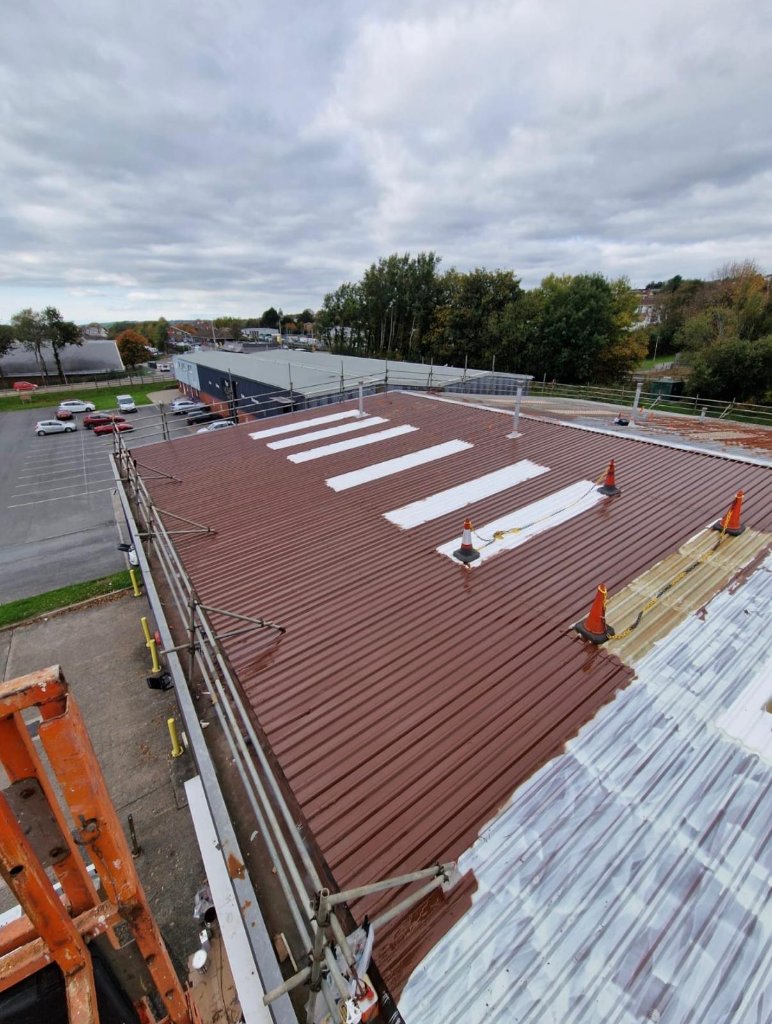
Asbestos Roof Repair
Targeted, compatible repair of localised defects — cracks, holes, leaking laps, failed fixings and ridge weatherings — on structurally sound asbestos-cement sheets. The controlled repair route where assessment confirms the material and defect remain suitable for in-place management.
Repair is the right response for the intact sheet with the localised defect
Defects can be localised at a crack, lap, fixing or ridge detail while other areas remain serviceable, but that cannot be assumed from the leak location alone. The assessment considers sheet condition, the extent of damage, access and the proposed activity before deciding whether a controlled repair is suitable or whether a wider response is required.
The discipline is to repair with the right system, in the right places, and only where the survey confirms the underlying sheet can stay in service. Forti Nova does not repair sheets that should be encapsulated — and does not encapsulate sheets that should be removed.
What can be repaired on an asbestos-cement roof
Cracked sheets
A repair method compatible with asbestos cement may be used to seal and protect a localised crack where assessment confirms the surrounding sheet can remain in service. The method and controls follow the material condition and task risk assessment.
Holes and localised delamination
Some local defects can be sealed or reinforced without replacing a complete roof plane. Widespread damage, significant break-up or loss of sheet integrity requires a different controlled response, which may include local sheet replacement or a wider removal scope.
Leaking laps and fixings
Lap seams and fixing penetrations can create local entry points. The detail, surrounding sheet condition and proposed repair method are assessed so the scope and fibre-control measures match the task.
Ridge, flashing and abutment failures
Where the sheet is intact but the weatherings have failed, the ridge, verge and abutment details are re-treated or re-flashed. This is repair work on the secondary weathering, not on the ACM substrate itself.
Failed sealant from previous patch repairs
Previous bituminous or mastic repairs may harden, crack, lose adhesion or retain moisture at the detail. Any removal and preparation method must be assessed and controlled before a compatible repair is specified.
Repair is appropriate when
- Sheets are structurally intact — no delamination, no sheet-scale fractures
- Defects are localised — individual cracks, holes or lap leaks
- Surface fibre release is minimal and confined to defect points
- The building use allows a local repair with less disruption
- The asbestos management plan supports ongoing in-place management
Beyond repair — escalate when
- Surface weathering is widespread across the sheet area
- Multiple fracture points indicate brittle, failing panels
- Waterproofing has failed across whole roof planes
- Sheets are delaminated or structurally compromised
- Defects are so extensive that encapsulation or removal is more economic
If the survey confirms the roof is beyond repair: read asbestos roof encapsulation for intact-but-weathered sheets, or asbestos roof encapsulation for a programme combining repair, encapsulation and waterproofing.
Asbestos roof repair — Frequently Asked Questions
When repair applies, what it covers, and when it isn't enough
Related asbestos roof resources
Technical guidance across the full asbestos-cement roof management lifecycle — diagnosis, repair, encapsulation, refurbishment, waterproofing and replacement decisions.
Repair only what needs repairing
A condition survey confirms which defects are genuinely localised and which signal wider deterioration. We specify targeted repair where the sheet can stay in service — and we will tell you plainly when it can't.
Request Condition Survey