
Commercial Roof Leak Repair
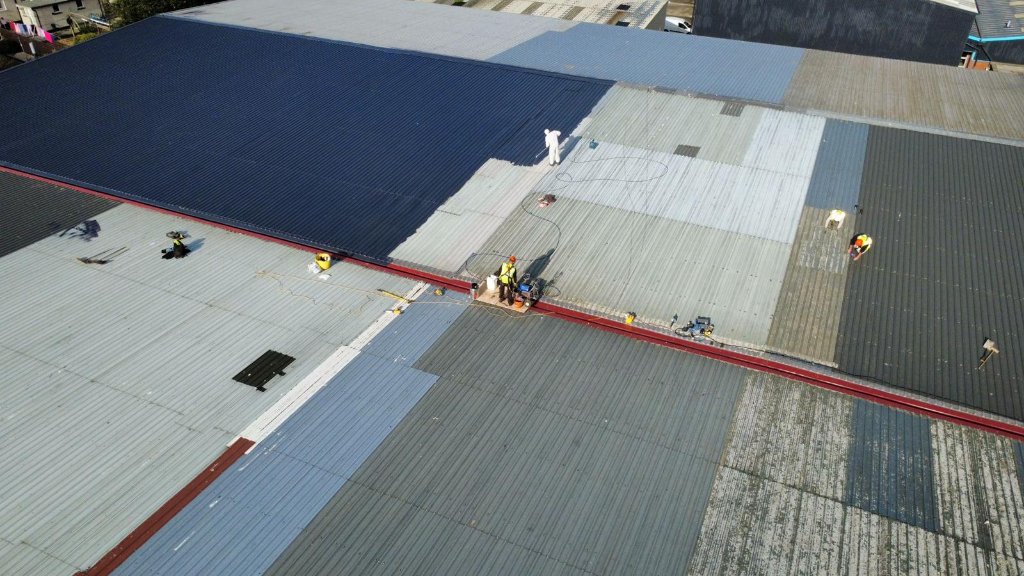
Commercial roof leak investigation and repair
The wet ceiling tile tells you where the water ended up. It does not necessarily tell you where the roof failed. We start by narrowing the entry route, then decide whether the correct response is a local repair or a wider roof assessment.
A roof leak is a symptom
A commercial building can leak because of the main roof membrane, but it can also leak through gutters, outlets, flashings, rooflights, penetrations, laps, fixings or local corrosion. The internal presentation may be some distance from that entry point.
That is why repeat patching without diagnosis can waste budget even when each individual patch is applied correctly.
Urgent ingress?
If water is affecting electrics, machinery, stock or occupied areas, manage the immediate internal risk first. Temporary containment may be appropriate while the permanent roof-side failure is investigated.
Likely Failure Points
Where commercial roof leaks can start
Membrane or coating defect
Splits, punctures, open seams, failed repairs or coating breakdown can create direct water-entry routes.
Upstand or flashing failure
Wall junctions, parapets, curbs, pipe penetrations and flashings can leak independently of the main roof membrane.
Rooflight or penetration detail
Aged seals, failed interfaces and movement around rooflights or service penetrations can create intermittent or wind-driven leaks.
Gutter or outlet failure
Blocked outlets, leaking joints, corroded box gutters or overflow can send water into the building away from the apparent roof defect.
Metal roof lap or fixing failure
On profiled roofs, laps, fasteners, washers, cut edges and flashings can all create leak paths even when the main sheet body remains serviceable.
Condensation or internal moisture
Not every drip originates outside. Condensation, services or internal moisture sources should be ruled out where the evidence points that way.
A useful leak investigation follows the water path
The goal is not to produce the longest survey report. It is to collect enough evidence to isolate the likely failure mechanism and understand whether the surrounding roof can support a repair.
Commercial roof survey- Record where water appears inside and under what weather conditions
- Inspect roof details around the likely drainage and water-travel path
- Check the main waterproofing for splits, failed seams, punctures or coating breakdown
- Inspect gutters, outlets, rooflights, flashings and penetrations
- Consider whether water may be tracking within insulation, deck profiles or structural channels
- Assess whether the surrounding roof is serviceable enough for a local repair
- Escalate to wider moisture or condition assessment when the leak pattern suggests more than one defect
Repair or refurbishment?
Local repair is appropriate when the defect can be isolated and the surrounding roof is serviceable. A refurbishment conversation becomes more relevant when leaks are recurring, several details are failing, moisture is spread through the build-up or the waterproofing has deteriorated more generally.
Commercial roof leak questions
Can you tell where a commercial roof leak is from the ceiling stain?
Not reliably. The stain shows where water became visible inside, not necessarily where it crossed the roof waterproofing. Water can travel before it appears, so the roof-side evidence still needs checking.
Does one leak mean the roof needs refurbishing?
No. A single local defect can often be treated as a repair where the surrounding roof remains serviceable. Refurbishment becomes relevant when failure is wider, recurring or linked to the condition of the roof system as a whole.
Can a leaking roof be repaired temporarily?
Temporary containment can be useful where active ingress is threatening stock, electrics or occupied areas. A temporary measure should still be followed by diagnosis and a permanent repair rather than being treated as the final specification.
Why do some roof leaks keep returning?
The original repair may have missed the entry point, the defect may be movement-related, the repair material may be incompatible, or there may be several failure points. Repeated leaks justify looking at the pattern rather than simply repeating the same patch.
Can you repair leaks on metal, EPDM and liquid roofs?
The diagnosis process applies across different roof types, but the repair materials and preparation are system-specific. The existing roof must be identified before a compatible repair is selected.
How quickly can a leak repair be done?
Timing depends on access, weather, roof type, investigation requirements, materials and the severity of the leak. We confirm the next practical step after reviewing the building information rather than promising a fixed mobilisation window online.
Your roof. Your next step.
Commercial roof leaking?
Send photographs of the roof, internal leak locations, the building location and anything you know about previous repairs. We can decide the most useful next step.